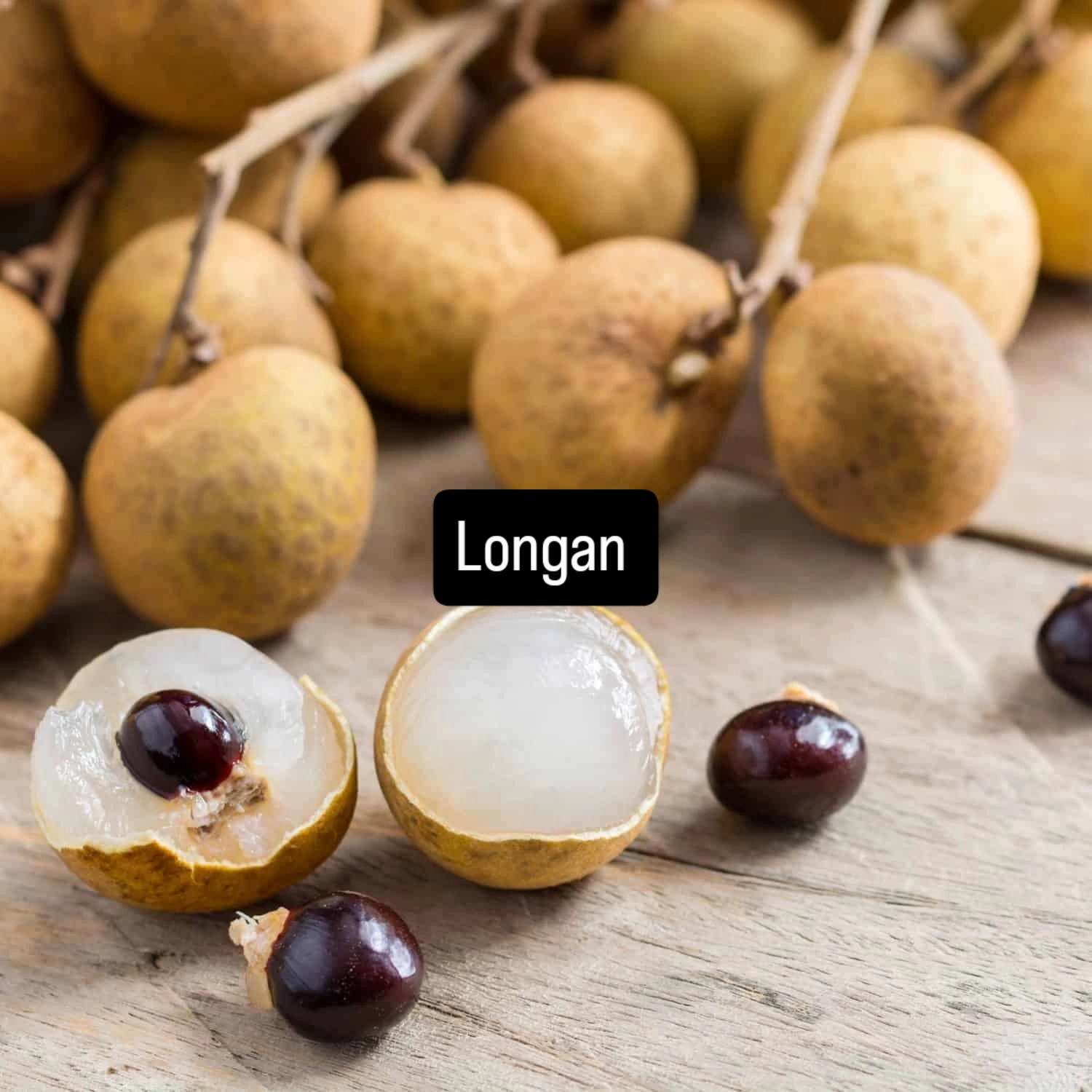
If your goal is early, reliable longan production for selling in Central Florida, the biggest issue isn’t simply making the tree grow faster—it is getting a mature tree to produce a strong flower flush at the right time.
UF/IFAS notes that longan trees can begin bearing about 3–5 years after transplanting, but unreliable flowering/bearing is a major production constraint. �
Ask IFAS – Powered by EDIS +1
The best strategy
1. Start with a grafted/air-layered tree, not seed
For a market-oriented planting, use a named, vegetatively propagated cultivar. Seedling longans can be much slower and unpredictable.
2. Don’t push nitrogen too hard
This is one of the biggest mistakes people make.
Heavy nitrogen = lots of lush vegetative growth but potentially poor flowering.
For established trees, UF/IFAS recommends substantially reducing the frequency of fertilizer applications compared with young trees; its Florida program for trees 7+ years old calls for fertilizer applications 2–4 times per year, rather than constantly feeding the tree. �
Ask IFAS – Powered by EDIS
For a production tree, I would aim for:
Healthy, dark-green foliage
Mature, hardened shoots
Moderate—not excessive—vegetative growth
Adequate potassium
Good micronutrient status
No continual nitrogen flush immediately before the desired bloom period
3. Let the tree harden off
Longan flowers are produced on mature growth. You don’t want to stimulate a big flush of soft new shoots immediately before you want flowers.
A useful production cycle is:
vegetative flush → shoots mature → growth hardens → induce flowering → bloom → fruit set → fruit development
That’s much better than keeping the tree in constant vegetative growth.
4. Water management becomes extremely important
Longan flowering is strongly influenced by environmental conditions, particularly the period leading into flowering.
For a commercial-style approach, you want the tree to experience an appropriate period of reduced water availability/stress, followed by irrigation when you’re ready to support flowering and fruit development.
However, don’t severely drought-stress a young or unhealthy tree. You’re trying to manipulate a mature, healthy tree—not damage the root system.
Once flowering and fruit set occur, water availability becomes much more important because prolonged drought can hurt fruit development.
5. Keep the tree small
This is particularly important if you’re growing for market.
UF/IFAS notes that longans can become 30–40 ft trees but can be maintained around 12–20 ft with periodic pruning. �
Ask IFAS – Powered by EDIS
For a small commercial planting, I’d strongly favor something like:
10–15 ft tall × 10–15 ft wide
rather than allowing a tree to become enormous.
That gives you:
Easier harvesting
Better spray coverage
Better sunlight penetration
Less ladder work
Easier pruning
More productive canopy per square foot
Lower labor costs
6. Don’t prune at the wrong time
Pruning immediately before your desired flowering period can remove the mature shoots that would otherwise produce flowers.
Instead, prune after harvest and give the tree time to produce and mature its new shoots.
Think of pruning as setting up next year’s crop rather than simply controlling tree size.
7. Keep micronutrients adequate
UF/IFAS specifically recommends foliar minor-element sprays containing nutrients such as:
Magnesium
Manganese
Zinc
Boron
Molybdenum
Sometimes iron
and recommends iron chelate applications during the June–September period in its Florida home-landscape program. �
Ask IFAS – Powered by EDIS
Don’t assume that more is better—particularly with boron. Use soil/leaf testing and product-label rates.
8. Choose the cultivar for your market
This may actually be more important than trying to force an inherently poor flowering tree.
If you’re selling fresh longan, I’d evaluate cultivars based on:
Trait
Importance
Reliable flowering in Central Florida
⭐⭐⭐⭐⭐
Early/desired harvest window
⭐⭐⭐⭐⭐
Sweetness/Brix
⭐⭐⭐⭐⭐
Large fruit
⭐⭐⭐⭐
Small seed
⭐⭐⭐⭐
Attractive shell
⭐⭐⭐⭐
Shelf life
⭐⭐⭐⭐
Consistent annual production
⭐⭐⭐⭐⭐
A tree that produces 80 lb reliably can be more valuable to a small grower than one capable of producing 150 lb but only crops sporadically.
The “market tree” approach
If I were setting up a small longan operation in Central Florida, I’d think about it this way:
Year 1–2:
Build roots, trunk and framework.
Year 3:
Allow limited fruiting if the tree is vigorous, but prioritize canopy development.
Year 4–5:
Start treating it as a production tree.
Mature tree:
After harvest → controlled pruning → mature shoot development → appropriate flowering conditions → bloom → fruit set → irrigation/nutrition for fruit development → harvest.
UF/IFAS indicates that longans may begin bearing 3–5 years after transplanting, although dependable production is a challenge. �
Ask IFAS – Powered by EDIS
One important warning about “flower-inducing” chemicals
You may encounter recommendations online for potassium chlorate (KClO₃) to force longan flowering. It can be an extremely powerful flowering treatment in longan production, but I wouldn’t recommend applying it casually to backyard trees. Rates, timing, tree condition, soil conditions, application method and regulatory considerations matter, and an overdose can seriously injure or kill a tree.
For a Central Florida market garden, I’d first optimize cultivar + tree maturity + pruning + nitrogen management + irrigation + nutrition before considering chemical flowering induction.
How to Grow Longan Trees in Florida
A Complete Central Florida Longan Growing Guide
Leave a Reply