Passion fruit is an exciting tropical fruit to grow in Central Florida, offering fragrant flowers, vigorous vines, and flavorful fruit that can be enjoyed fresh or used in juices, desserts, sauces, and homemade preserves. However, choosing the right variety can make a big difference in how well your vine grows and how much fruit it produces.
Central Florida’s warm growing season is ideal for passion fruit, but occasional winter freezes, sandy soils, and differences in pollination requirements can create challenges. Some varieties are better suited to warmer climates, while others offer excellent flavor and relatively dependable fruit production under suitable conditions.
Whether you are planting a passion fruit vine in your backyard, establishing an edible garden, or exploring small-scale fruit production, this guide will help you understand the best varieties to consider.
1. What Makes a Passion Fruit Variety Good for Central Florida?
Before selecting a variety, consider the conditions it will face in Central Florida.
The best choice should ideally offer several of these characteristics:
– Heat tolerance: The ability to grow and produce fruit during Florida’s warm growing season.
– Good flavor: Sweet, aromatic pulp with a pleasant balance of sweetness and acidity.
– Reliable fruit production: A variety that flowers and sets fruit consistently under suitable conditions.
– Manageable pollination requirements: Self-compatible varieties can be easier for beginners because a second genetically different vine may not be necessary.
– Disease resistance: Resistance or tolerance to root problems and other common diseases can improve the plant’s chances of long-term success.
– Adaptability: The ability to perform well in the local soil and climate.
– Useful fruit characteristics: Fruit size, pulp quantity, juice content, and skin thickness matter if you plan to use or sell the harvest.
One important consideration is winter cold. Traditional purple passion fruit is generally better adapted to cooler tropical highland conditions, while yellow passion fruit and many purple-yellow hybrids are better suited to warmer, low-elevation climates.
However, no common edible passion fruit variety should be considered reliably freeze-proof in Central Florida.
2. Possum Purple Passion Fruit
Best for: Home gardeners who want flavorful fruit and a variety with documented Florida growing experience.
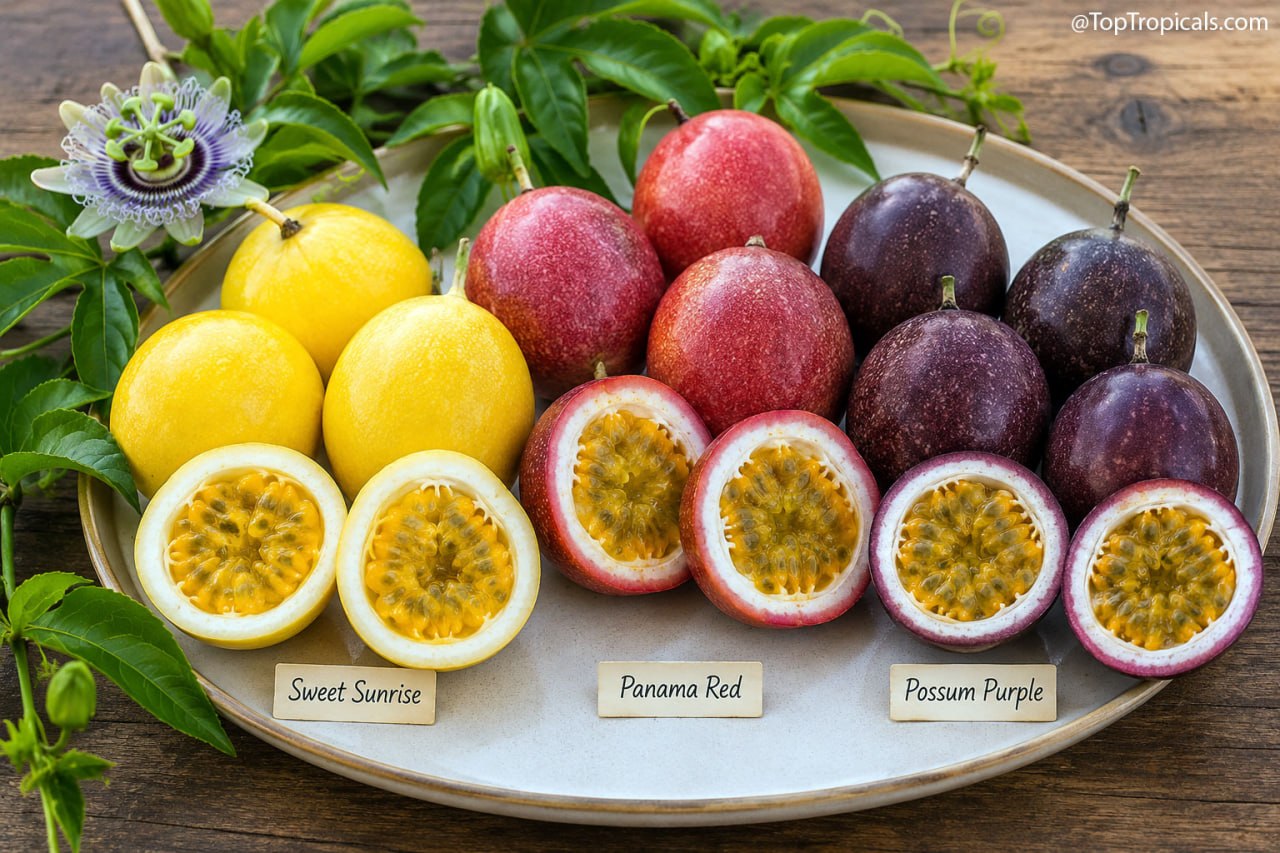
Possum Purple is one of the most widely grown and propagated passion fruit selections in southern Florida. Despite its name, it is understood to have mixed purple-yellow ancestry rather than being a pure purple type.
The fruit typically has medium-dark purple skin with light-colored speckles. It is aromatic and produces juice with a pleasant, moderately strong, sweet flavor.
Why Grow Possum Purple?
– Pleasant flavor suitable for fresh eating.
– Attractive purple fruit.
– Documented performance in Florida.
– Self-compatible flowers, which can simplify pollination.
– Suitable for juices, smoothies, desserts, and sauces.
Possum Purple is a particularly appealing option for gardeners who want to begin with a recognized Florida selection rather than an unidentified seedling.
Potential Drawbacks
Possum Purple is not immune to winter damage, root diseases, or other growing problems. It still needs good drainage, adequate sunlight, a sturdy trellis, and protection from severe cold.
Our recommendation: Possum Purple is one of the first varieties worth investigating for a Central Florida home garden, especially if flavor and manageable pollination requirements are priorities.
3. Bounty Passion Fruit
Best for: Gardeners interested in a productive vine with smaller, flavorful fruit.
Bounty is a passion fruit selection reported in Florida growing circles. The fruit is generally smaller than that of some large-fruited selections, and its flavor is described as sweet-tart.
Bounty is also reported to be self-fertile, making it potentially useful for gardeners who prefer to grow a single vine.
Why Grow Bounty?
– Reported to be self-fertile.
– Sweet-tart fruit suitable for fresh use and processing.
– Worth considering for backyard production.
– Potentially convenient where space allows only one vine.
Potential Drawbacks
Detailed, independently verified comparisons of Bounty’s yield, disease resistance, and cold tolerance are limited. Its performance can vary with growing conditions and plant identity.
When buying Bounty, ask the nursery whether the plant is a correctly identified, vegetatively propagated selection rather than a seedling whose characteristics may differ from the parent.
Our recommendation: Bounty is worth considering if you want a potentially self-fertile selection, but ask the supplier for local performance information before choosing it over a better-documented cultivar.
4. Sweet Sunrise Passion Fruit
Best for: Gardeners who want large yellow fruit and are prepared to manage cross-pollination.
Sweet Sunrise is a yellow-fruited passion fruit variety available through some Florida tropical fruit nurseries.
Its fruit can grow to approximately the size of a baseball and has a sweet, tangy flavor. Yellow passion fruit is often valued for its juice production and relatively substantial fruit size.
Why Grow Sweet Sunrise?
– Large, attractive yellow fruit.
– Sweet-tart flavor.
– Potential for juice, beverages, sauces, and other recipes.
– A useful option for gardeners interested in yellow passion fruit.
Potential Drawbacks
Many yellow passion fruit selections are self-incompatible, meaning their flowers cannot reliably use their own pollen to produce fruit.
Sweet Sunrise should therefore be grown with a compatible, genetically different vine unless the supplier confirms otherwise for the specific selection. Hand pollination may also be helpful.
A second vine increases planting costs and requires additional trellis space.
Our recommendation: Sweet Sunrise is worth considering if you prefer yellow fruit and are willing to plant a compatible pollinator. Confirm its pollination requirements before purchasing.
5. Panama Red Passion Fruit
Best for: Growers interested in large, red-skinned fruit and potentially substantial harvests.
Panama Red produces oval fruit with red skin when ripe. The fruit can be larger than Possum Purple, with a similar general flavor profile.
The cultivar is associated with selections developed for productive growing conditions, although actual performance depends on the plant and its environment.
Why Grow Panama Red?
– Large, visually appealing red fruit.
– Useful for fresh eating and processing.
– Worth considering for a tropical fruit collection.
– Potential appeal to customers interested in unusual fruit colors.
Potential Drawbacks
Panama Red’s pollination behavior should be confirmed with the nursery selling the plant. Some selections require pollen from a compatible vine.
Its cold tolerance and disease resistance should also not be assumed to be superior to other varieties without reliable local evidence.
Our recommendation: Panama Red is an interesting choice for gardeners who want larger red fruit, particularly when they have room for more than one vine.
6. Whitman Yellow Passion Fruit
Best for: Gardeners interested in an established yellow-fruited selection.
Whitman Yellow is a selection associated with William Whitman, a well-known figure in Florida tropical fruit growing.
Like other yellow passion fruit types, it is of interest to gardeners who want to grow yellow-skinned fruit for juice and culinary uses.
Why Consider Whitman Yellow?
– Yellow fruit suitable for juice and other recipes.
– An established name in Florida tropical fruit growing.
– Worth investigating for collectors and experienced growers.
Potential Drawbacks
Information comparing Whitman Yellow’s yield, disease resistance, and performance specifically in Central Florida is limited.
As with other yellow selections, confirm whether a compatible second vine is necessary for reliable fruit set.
Our recommendation: Whitman Yellow is worth considering when a reputable nursery can provide a correctly identified plant and guidance about its local performance.
7. Purple Passion Fruit Types
Best for: Gardeners who prioritize traditional passion fruit flavor and convenient pollination.
Purple passion fruit is the familiar type many people recognize from grocery stores and recipes. Its fruit typically develops dark purple skin when mature, with aromatic pulp that combines sweetness and acidity.
Purple passion fruit varieties are often preferred for fresh consumption because of their flavor.
Why Grow Purple Passion Fruit?
– Distinctive, aromatic flavor.
– Suitable for eating fresh.
– Excellent for desserts, beverages, and sauces.
– Many varieties are self-compatible.
– Attractive fruit and flowers.
Potential Drawbacks
Traditional purple types are generally associated with cooler tropical highland conditions compared with yellow types and many hybrids. This can make heat adaptation an important consideration in Central Florida.
Some purple types are also susceptible to root-knot nematodes and other root problems.
Remember that not all purple-fruited plants are identical. A named cultivar, a hybrid, and a seed-grown plant can perform differently.
Our recommendation: Purple passion fruit is a good option for gardeners who prioritize flavor, but choose a cultivar with a track record in Florida rather than assuming every purple variety will perform equally well.
8. Maypop: A Cold-Hardy Native Alternative
Best for: Gardeners who want a native passionflower that can tolerate colder conditions.
Maypop (Passiflora incarnata) is a passionflower native to the southeastern United States. It is considerably more cold-hardy than tropical passion fruit and can grow in parts of Florida where tropical vines face greater winter risks.
Its fruit is generally yellow-green and may have a mild or slightly sweet flavor.
Why Grow Maypop?
– Native to the southeastern United States.
– Much more cold-hardy than tropical passion fruit.
– Produces attractive flowers.
– Can support native butterfly species, including Gulf fritillaries and zebra longwings.
– Worth considering for native gardens and wildlife-friendly landscapes.
Potential Drawbacks
Maypop is not a direct substitute for commercial tropical passion fruit varieties. Its fruit flavor, size, and pulp characteristics differ from those of typical purple and yellow Passiflora edulis selections.
It can also spread vigorously through underground growth, so it may require management.
Our recommendation: Consider Maypop if winter survival and native wildlife value are more important than producing the familiar tropical passion fruit found in stores.
9. Which Passion Fruit Variety Is Best for Central Florida?
The right choice depends on your goals, the variety’s verified characteristics, and the conditions at your planting site.
Here is a practical comparison of the varieties discussed above.
Variety| Fruit color| Main attraction| Pollination considerations
Possum Purple| Purple| Flavor and Florida growing experience| Self-compatible
Bounty| Purple to mixed tones| Sweet-tart fruit| Reported to be self-fertile
Sweet Sunrise| Yellow| Large fruit and juice| Confirm compatibility requirements
Panama Red| Red| Large, attractive fruit| Confirm compatibility requirements
Whitman Yellow| Yellow| Established yellow selection| Confirm compatibility requirements
Purple passion fruit types| Purple| Traditional aromatic flavor| Many are self-compatible
Maypop| Yellow-green| Cold hardiness and native wildlife value| Species-specific pollination needs
This table summarizes general characteristics, not a controlled ranking of yields or cold tolerance. Cultivar identity and local growing conditions matter, and detailed performance comparisons for Central Florida remain limited.
10. Should You Grow Purple, Yellow, or Hybrid Passion Fruit?
For many Central Florida gardeners, this is the most important decision.
Purple Passion Fruit
Purple types are attractive for fresh eating and their familiar sweet-tart flavor. Many are self-compatible, which can simplify growing a single vine.
However, traditional purple types may be less suited to prolonged heat than yellow types and some hybrids.
Yellow Passion Fruit
Yellow types are often better adapted to warm, low-elevation conditions and can produce large fruit. They may be especially useful for juice and processing.
The major consideration is pollination. Many yellow selections need pollen from a genetically different compatible vine.
Purple-Yellow Hybrids
Hybrids can combine desirable characteristics from both groups. Many selections grown in Florida fall into this category.
However, hybrids differ considerably. Some are self-compatible, while others benefit from or require cross-pollination.
For beginners: Start by looking for a named selection with a demonstrated history of growing successfully in Florida. Ask about pollination requirements before purchasing, and avoid assuming that fruit color alone predicts performance.
11. Where to Buy Passion Fruit Plants in Florida
Purchasing a healthy, correctly identified plant from a reputable nursery is generally the best starting point.
When comparing suppliers, ask the following questions:
1. What is the exact cultivar name?
2. Is the plant propagated from a cutting or graft, or was it grown from seed?
3. Has this cultivar performed well in Central Florida?
4. Does it require cross-pollination?
5. Is it known to have problems with root-knot nematodes or other diseases?
6. Is the plant acclimated to outdoor Florida conditions?
Vegetatively propagated plants, such as rooted cuttings or grafted plants, are generally more predictable than seedlings because they retain the characteristics of the selected parent.
Seed-grown vines can be productive, but their fruit color, flavor, growth, and pollination characteristics may differ from those of the parent plant.
Before ordering online, check shipping conditions, plant health, and whether the nursery provides a clear cultivar identification.
12. How to Get the Best Results From Your Chosen Variety
Even an excellent cultivar can disappoint if its basic growing requirements are overlooked.
For better results in Central Florida:
– Plant in a sunny location with at least six hours of direct sunlight.
– Choose well-drained soil.
– Install a strong trellis before the vine becomes large.
– Water consistently during dry periods.
– Use fertilizer according to soil-test results and label directions.
– Avoid excessive nitrogen, which can encourage foliage at the expense of flowers.
– Encourage pollinators and use hand pollination when needed.
– Protect young vines from freezing weather.
– Inspect the plant regularly for pests, diseases, and nutrient problems.
Successful pollination is especially important. A vine can produce many flowers but little fruit if pollen does not reach a receptive stigma. If your plant flowers without setting fruit, verify its compatibility requirements before concluding that the variety is unsuitable.
13. Can You Make Money Growing Passion Fruit in Central Florida?
Passion fruit may offer an opportunity for small-scale fruit sales, but profitability depends on the variety, growing conditions, labor, yield, and access to customers.
Fresh passion fruit can appeal to customers interested in tropical produce, specialty fruits, homemade juices, desserts, and locally grown food.
Before investing in multiple vines, consider:
– How much usable fruit each vine produces.
– Whether the fruit has the flavor and size your customers prefer.
– How much time is required for pruning, pollination, harvesting, and sorting.
– Whether winter cold or disease could interrupt production.
– How much you will spend on plants, trellises, irrigation, fertilizer, and replacement vines.
– Whether local markets, restaurants, or direct customers are interested in buying the fruit.
A sensible approach is to begin with a few varieties, record their performance over several growing seasons, and expand only after identifying which plants consistently produce marketable fruit.
Do not assume that a variety advertised as high-yielding will necessarily be the most profitable in Central Florida. A slightly lower-yielding plant may be more economical if it has better fruit quality, fewer disease problems, or simpler pollination requirements.
Final Thoughts: Choosing the Best Passion Fruit for Central Florida
Central Florida gardeners have several promising passion fruit varieties to explore, but no single cultivar is guaranteed to perform best at every location.
Possum Purple is a particularly useful starting point because it has documented Florida growing experience, appealing flavor, and self-compatible flowers. Bounty is another option worth investigating, while Sweet Sunrise, Panama Red, and Whitman Yellow offer alternatives for gardeners interested in yellow or red fruit.
Maypop is a different choice altogether, providing greater cold hardiness and native wildlife value rather than the same tropical fruit characteristics.
The most important step is to select a correctly identified plant that suits your climate, pollination needs, and growing goals. Combine that choice with good drainage, reliable watering, a strong trellis, and winter protection.
With careful selection and proper care, passion fruit can be a rewarding addition to a Central Florida garden and may even become the foundation of a small specialty-fruit venture.
Recommended Resources
For additional information about passion fruit varieties, pollination, cultivation, and Florida production, consult these University of Florida IFAS Extension resources:
– The Passion Fruit in Florida: https://ask.ifas.ufl.edu/publication/HS1406
– The Emerging Passion Fruit Industry in Florida: https://ask.ifas.ufl.edu/publication/HS1467
– Passion Fruit Problems in the Home Landscape: https://ask.ifas.ufl.edu/publication/HS1397
Leave a Reply